(West Hill)
Monday, November 24, 2008, 8:03 AM

West Hill is at the west suburb some 15 kilometers from the city proper. It contains the Huating Hill, Taihua Hill and Luohan Hill, extending a distance of more than 40 kilometers at an altitude of between 1900 meters to 2350 meters above sea level.
Legend goes that at ancient time locals mistook a phoenix for Jade Chicken and called the hill Jade Chicken Hill. The hill also called Lying Buddhist Hill for its resemblance of a sculpture of a lying Buddha.
West Hill is very beautiful with lush vegetation, blooming flowers, green grass and tranquil surroundings. West Hill has enjoyed great fame for its beautiful and unique natural scenery since ancient time and was renowned as " the most beautiful place in Yunnan". Looked from afar, the mountain looks like a sleeping beauty lying on the Dianchi Lake. The girl looks so fascinating with her dark long hair flowing on the water face and you can even distinguish her head, breast, belly and two slim long legs.
A tragic story related to this hill said that in remote time, a pretty princess escaped from the palace to seek freedom and love. The girl later met her prince and they got married soon. Unfortunately, their marriage encountered the king's strong opposition, who later killed that her husband. The princess was so sorrow that she cried days and nights and tears fell from her face and formed the Dian Lake. The girl's body formed the West Hill.
West Hill has become a popular attraction with many scenic spots. Each spring, the locals will gather here singing folk songs, playing dragon and lion show and enjoying the stunningly beautiful scenery around.
Looked afar, the mountain resembles a sleeping beauty lying on the Dianchi Lake. 19 kilometers from Kunming proper, Xishan is also known for stone sculptures on the cliff, represented by the Dragon Gate, which took 72 years to complete. Tourists can take a bird-eye view of the grand Dianchi Lake from the spot of the Dragon Gate.
Attractions here include the Huating Temple,Taihua Temple, Sanqingge Pavilions, Longmen Grotto.
Huating TempleAt the belly of the West Hill, it is one of the grander Buddhist Temples in the region with a history of over 900 years. The temple has undergone several repair and reconstruction and the complex existing today was built in 1923 by a monk here. The temple contains a Great Hall, Heavenly Hall and Guanyin Tower, a tower for a huge clock, Yuhua Terrace and some other ancient buildings. In the Great Hall places three delicately carved golden Buddhist scriptures. The scriptures are in looks and grandeur in posture.
Taihua TempleTiahua Temple is at the highway up the Tiahua Mountain. The temple was built in the Yuan dynasty hundreds of years ago. It contains a Great Hall, A heavenly Hall, a Elusion Tower and Grand-view Pavilion and some mansions and winding corridors. Taihua Temple has been famous the lush vegetation and blooming flower in the temple. In later spring or early summer, variety of flowers scatter everywhere around the temple with the camellia, yulan the most impressive and famous. The area around the temple is blanketed by bamboo forest and old trees.
Outside the gate of the temple grows a 600-year old gingko tree, whose trunk takes four –five men to circle with their arms stretched out. The branches of the tree spread out in all directions. The tree was said to be planted by one of the Ming Emperors.
Sanqingge PavilionsThe complex stands on a sheer cliff and is heavily sheltered by green vegetation. It contains 11 buildings including Linguang Hall, Laojun Hall and so on. The bird-eye view from the buildings top is superlative with precipitous rocks, tree-sheltered pavilions, towers.
Longmen GrottoThis is the largest and most beautiful Taoist stone carvings in Yunnan. It has four famous features of uniqueness, distinctiveness, danger and tranquility. Longmen Grotto ranks top of all the cultural heritage in and around Kunming and enjoys great fame internationally.
Best Time to Visit: Kunming is called the city of perpetual spring and is suitable for tourists all year around. However, spring is the best time to visit West Hills for the scenery is the best there and many local people visit the place at March 3rd of the lunar calendar.
(Stone Forest)
7:58 AM

Being one of the National Scenic Resorts in China, Stone Forest Scenic Resort is 83km from Kunming and has a complete range of karst formations. Among the most wonderful attractions in this area are the following eight scenic spots: Large & Small Stone Forests, Naigu Stone Forests, Large & Small Zhiyun Caves, Qingfeng Cave, Long Lake, Moon Lake, Fairy Lake, Feilong Falls. Standing upright in the Stone Forest are innumerable cliffs and peaks, lofty and majestic, steep and precipitous, charming and enchanting.
An interesting legend related the attraction goes that a heroine Asham of the Sani( the Sani people are a branch of the Yi nationality living in Yunnan province) was bore into a poor family in today's Yunan region. The girl was very clever and she began helping her father herd sheep at the age of 12. One day in the mountains she saved a boy named Ahei who had lost his way while picking wild fruit. Ahei, a 12-year-old orphan, had to toil for the landlord. Sympathizing with the poor boy, Ashma took him home. Ashma's parents took pity on Ahei and fostered him. Ahei and Ashma grew up together and they fell in love with each other. They got married and lived a happy life. But Ashma was later abducted by the man, Azhi, the landlord's son who was eager for the lady's beauty. When Ahei-the husband learnt the event, he killed the landlord and his son and rescued his wife-Ashma. The lovers went into the stone forest and lived happily there ever after, giving birth to fine sons and daughters who are said to be the ancestors of the Sani people.
From afar, it really looks like a dense forest but as you walk closer, you will find "trees" are all slender stone pinnacles. The sight is vast covering some 350 kilometers. The Yi and Sani ethnic group who live there are hardworking and good at singing and dancing. Their folklore and culture are colorful and multifarious, backed up by a long history.
Food: Tourists can taste the delicious local food, such as the edible wild mushrooms, Yi people's Tofu feast, and so on.
Shopping: Tourists can buy the handicraft works, minority clothes and the folk paintings in Stone Forest.
The best time to visit the Stone Forest is when especially the Greater and Lesser stone forests, is September to May next year.
(DianChi Lake)
7:57 AM

Called Kunming Lake, Dian Lake is in the southwest of the Kunming City. The lake was so named for an ancient Dian tribe living in this area. The crescent-shaped lake extends 39 kilometers from north to south and around 13 kilometers from west to east at an altitude of 1886 meters above sea level. Occupying an area of 306 kilometers, the lake have water capacity of 15,7 hundred million cubic meters. Dian Lake is surrounded by hills on four sides with the Jinma Hill in the east, Biji Hill in the west, Heshan Hill in the south and (sheshan Hill) Snake Hill in the north. The area on the lake shore is fertile with comfortable weather condition, abundant rivers for irrigation.
Dian Lake has a long history. In the Warrior Period, a Dian State was built in this region. Dian Lake with crystal clean water, ripple lake surface, boats sailing on the lake looks like a glittering pearl set on a mountain basin and reflects the surrounding mountains the blue sky. The area around the Dian Lake is clustered with sights of either beautiful scenery or rich cultural heritage. These include the Nanyun Nationalities Villages, West Hills, Grand View Park.
Best Time to Visit: The place is most beautiful in spring when sakura flowers bloom and it looks brilliantly red everywhere.Recommended Time for a Visit: Half a day is enough if tourists do not take a boat to view the lake. The lake is surrounded by high roads. Tourists can also rent a bicycle and ride around the lake, which takes about two days.
(JiuXiang)
7:51 AM

Jiuxiang Scenic Spot is 20 sq km in area and includes 5 tourist attractions, Diehong Bridge (5 km southeast from Jiuxiang Street, famous for the karst caves, the twin waterfalls and the huge natural stone dam cluster), Dasha Dam (consisting of picturesque karst caves and thick forest), Sanjiao Cave (5 km north of Jiuxiang Street, famous for the karst caves), Alu Long [a scenic area 6 km west of Jiuxiang Street, famous for the excavated Yi Nationality cliff paintings of Qin 221BC-206BC) and Han (206BC-220AD) dynasties] and Mingyue (meaning the bright moon)
Lake.
Jiuxiang is known as the "museum of karst caves", which boasts its caves as the largest in scale and number (there are about a hundred karst caves) and has the most wonderful in-cave scenes in China. The caves in Jiuxiang fall into 4 cave clusters: Sanjiao Cave, Dashang Cave, Diehong Cave and Dasha Dam Cave. 66 out of the numerous caves in the area are profitably exploitable and the karst cave cluster is the largest of its kind on Yunnan-Guizhou plateau. The caves in the area are praised for their grandeur, wonder grotesquerie and natural beauty.
Jiuxiang, the birthplace of the aboriginal Yi ethnic people, has a strong minority custom color, a long cultural history, and widely spread old myths and tales. These include Hunting Festival, the Worship the White Dragon Festival, Love Song Contest, Bullfighting, Wrestling, Sanxian Dance (Sanxian is a three-stringed plucked instrument), Rattle Stick Dance and so on.
Tourists should take enough clothes since they may get wet in boats when they visit the karst caves and the gorges. The folk songs and dances and the local food are also special. What's more, Yangzonghai Lake Scenic Spot and Little White Dragon Forest Park are not far from Jiuxiang Scenic Spot. Tourists can take buses at the gate of the Jiuxiang to go there.
(YunNan Ethnic Villages)
7:50 AM

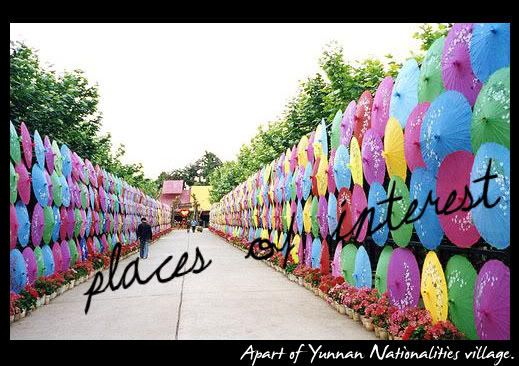
This wonderful theme park displays the colorful folklore and architectures of 25 ethnic group in Yunnan Province through shows and performances, a folklore museum and a wax museum for folklore, as well as the copy buildings of villages of the 25 ethnic groups.
Yunnan Nationalities Villages is at a narrow peninsular at the north shore of the Dian Lake. Ethnical villages of over 25 minorities including Yi, Dai, Miao, Jingpo, Wa, Hani, Naxi, Dulong and so on have been built here. Through ways of display and recreation of the original villages, Yunnan Nationalities Villages present the diverse local ethnical culture.
Villages of different styles are well arranged and show visitors their unique charm. Displaying the variety of buildings, lifestyles, religious belief in this region, the villages are microcosm of Yunan's colorful and diverse ethnical culture.In the Yunnan Nationalities Villages, visitors can enjoy not only variety of architecture arts, clothing, remarkable custom, also ethnical shows of songs and dance. Trying the fantastic food and purchasing some lovely souvenirs to bring home also provide a memorable experience. Some traditional festivals of these ethnical groups are held here including the Sanyuejie Festival of the Bai people, Splashing Water festival of Dai, Torch Festival of Yi and Three Flowers festival of Naxi People and much more.
The ethnic singing and dancing performances and the folk performances are from 9:00 to 17:00, mainly in the Dancing Hall and Tuanjie Square. The Asian Elephants performances are specially recommended.
(Daguan Park)
7:47 AM

The Daguan Park is located at the terminus of Daguan Road and is 6 km from the city center, near Dianchi Lake and facing Taihua Mountain which is on the other side of Dianchi Lake.
The Park Scenic Area includes the three-storied Grand View Pavilion, which provides a spectacular view across sparkling Dianchi Lake to the distant Western Hills, and some winding corridors, bonsais, rockeries, trees and porches, willowed causeways, arch bridges, and archways centering around.
The pavilion was built in 1890. The roofs of the pavilion were painted golden, and the pavilion appears elegant in between the verdant trees. The pavilion faces north and south, with the south gate (the facade) facing water (Dianchi Lake); on both sides of the south gate were the couplet written by Sun Ranweng (1684-1763, a poor scholar in Qing Dynasty); this couplet of 180 Chinese characters is believed to be the longest antithetical couplet in the world and one of the most valued cultural treasures in Yunnan. The first part (on the right) of the couplet describes the beautiful and magnificent natural views around Kunming, e.g. the local mountains and extolling nature in an optimistic mood. The second part (on the left) reviews the 2,000 years' history of Yunnan, commemorating its rulers and warriors, battles and victories and indicating that no matter how successful or frustrated you are, all will be in nothingness in the end. The words are carefully chosen. The language is beautiful and elegant.
Inside the pavilion on the third floor, looking into the distance, you will have a panoramic view of Dianchi Lake and the Western Hills.
(YuanTong Temple)
7:45 AM

Yuantong Temple is at the foot of the Luofeng Hill in the northern part of the city. It is the largest Buddhism temple in Kunming, where the Yunnan Provincial and the city's Buddhism Commission are based.
The temple was built in the Tang Dynasty, with a history of over 1,200 years. In the Ming and Qing Dynasties, the temple was reconstructed and repaired for several times to the present size. The temple is now of the most important Buddhist temples under the state's special protection.
Contrary to other temples, which were built on an ascendant, you enter Yuantong Temple from above. The temple's great hall was at the lowest point of the temple. The temple's layout itself and Buddhist Scriptures in it follow the Yuan and Ming styles.
Yuantong Temple is grandeur, unique. Its brilliant appearance, grand building complex and tranquil surroundings have intoxicated generations of poets, painters who written poems, brushed scrolls about it.
The only Buddhist temple within the city, Yuantong temple is very popular among tourists and pilgrimages alike. Throngs swarm to the temple all year round. The temple is particularly crowded during the Qingming Festival, the first day and fifth day of each lunar month.
 West Hill is at the west suburb some 15 kilometers from the city proper. It contains the Huating Hill, Taihua Hill and Luohan Hill, extending a distance of more than 40 kilometers at an altitude of between 1900 meters to 2350 meters above sea level.
 Being one of the National Scenic Resorts in China, Stone Forest Scenic Resort is 83km from Kunming and has a complete range of karst formations. Among the most wonderful attractions in this area are the following eight scenic spots: Large & Small Stone Forests, Naigu Stone Forests, Large & Small Zhiyun Caves, Qingfeng Cave, Long Lake, Moon Lake, Fairy Lake, Feilong Falls. Standing upright in the Stone Forest are innumerable cliffs and peaks, lofty and majestic, steep and precipitous, charming and enchanting.
 Jiuxiang Scenic Spot is 20 sq km in area and includes 5 tourist attractions, Diehong Bridge (5 km southeast from Jiuxiang Street, famous for the karst caves, the twin waterfalls and the huge natural stone dam cluster), Dasha Dam (consisting of picturesque karst caves and thick forest), Sanjiao Cave (5 km north of Jiuxiang Street, famous for the karst caves), Alu Long [a scenic area 6 km west of Jiuxiang Street, famous for the excavated Yi Nationality cliff paintings of Qin 221BC-206BC) and Han (206BC-220AD) dynasties] and Mingyue (meaning the bright moon)

 Yuantong Temple is at the foot of the Luofeng Hill in the northern part of the city. It is the largest Buddhism temple in Kunming, where the Yunnan Provincial and the city's Buddhism Commission are based.